Branding in the Age of AI: Why Unique Design Matters
AI tools have made it easier than ever to create a logo, a website, or a full set of social graphics in minutes. For a busy business owner, that's tempting. But branding in the age of AI comes with a catch that's easy to miss when you're the one typing the prompt: people can tell. When your branding looks AI-generated, your audience doesn't see your business. They see AI.
After more than 15 years as a brand and web designer, I've watched a lot of design trends come and go. This one is different. It isn't a style trend. It's a shift where more and more brands are starting to look exactly alike. In this post, I'll walk through why that happens, why it matters for service-based businesses, what you may not actually own, and where AI genuinely fits into building a brand.
Why AI Design All Starts to Look the Same
AI design tools learn from what already exists online. When you ask for a logo, the tool pulls from patterns it has seen thousands of times and gives you something close to the average. That's why AI logos often look polished at first glance but strangely familiar.
You've probably seen the signs:
The same glossy gradients and soft glows
"Safe" fonts that could belong to any business
Generic icons like leaves, lightbulbs, swooshes, and abstract circles
Images that look a little too smooth and perfect to be real
The bigger issue is that the more people use these tools, the more the results start to blend together. If your logo came from the same tool, using a similar prompt, as hundreds of other businesses, it's hard for it to feel like yours.
People Notice, and It Costs You Trust
Not long ago, someone reached out to me about improving a website they had built for their product business. The site worked. Technically, it was all there. But every product image was heavily AI-generated, with no real photos anywhere. The logo was AI-generated too. The whole site looked generic, and honestly, that's all I could see. As a customer, I would never have felt comfortable buying from it and would actually wonder if it was a scam.
That's the real cost. Your audience may not be able to explain why something feels off, but they feel it. And when it comes to spending money, that hesitation matters.
This is especially true for service-based businesses. If you're a therapist, dietitian, interior designer, or coach, clients aren't just buying a service. They're choosing a person they trust. Your branding is often the first impression of that trust. I wrote more about this in my post on the importance of personal branding for women-owned businesses, and the same idea applies here: authentic brands connect, and generic ones get scrolled past.
Don't Be Fooled by the "Wow" Moment
Part of what makes AI so appealing is the speed. You type a few words, and seconds later you have something that looks pretty good. That first reaction is usually, "Wow, this is actually great."
But look again. On closer inspection, the cracks start to show: lettering that's slightly off, details that don't make sense, colors that don't match your business, or a design that could belong to anyone. Then the "quick" logo turns into hours of fixing, tweaking, and regenerating, and you still don't have something that feels like yours.
Being able to make something in a snap doesn't mean it's the right thing for your business. Before you commit to anything, AI-made or not, step back and look at it critically. Ask yourself whether it truly represents your business, whether it would stand out next to your competitors, and whether you'd be proud to see it on a sign or a business card five years from now.
The Subtle Details a Trained Eye Catches
Good design often comes down to details most people never consciously notice, but always feel. These are the things a trained designer looks at that AI tools usually miss:
Spacing and letter spacing. Small adjustments between letters and elements make a logo feel balanced and intentional instead of slightly off.
Legibility at every size. A logo needs to work as a tiny social media profile image and on a large sign. Many AI logos fall apart when they shrink.
One-color versions. Your logo should still work in black and white, on a photo, or embroidered on a shirt.
A full brand system. A brand isn't one image. Many people using AI end up with a single logo and nothing else. A real brand system includes a primary logo, secondary logo, and submark, plus color and black-and-white versions, a color palette, and fonts that all work together. That's what keeps your brand consistent on your website, social media, business cards, and signage.
Vector files. Most AI tools create raster images, which are made of pixels. Enlarge them and they get blurry or jagged. A professionally designed logo is built as a vector file, which stays crisp at any size. That matters for print, embroidery, large signage, and anything a printer or vendor needs to reproduce cleanly.
Meaning. Every choice should connect to your business, your audience, and your story.
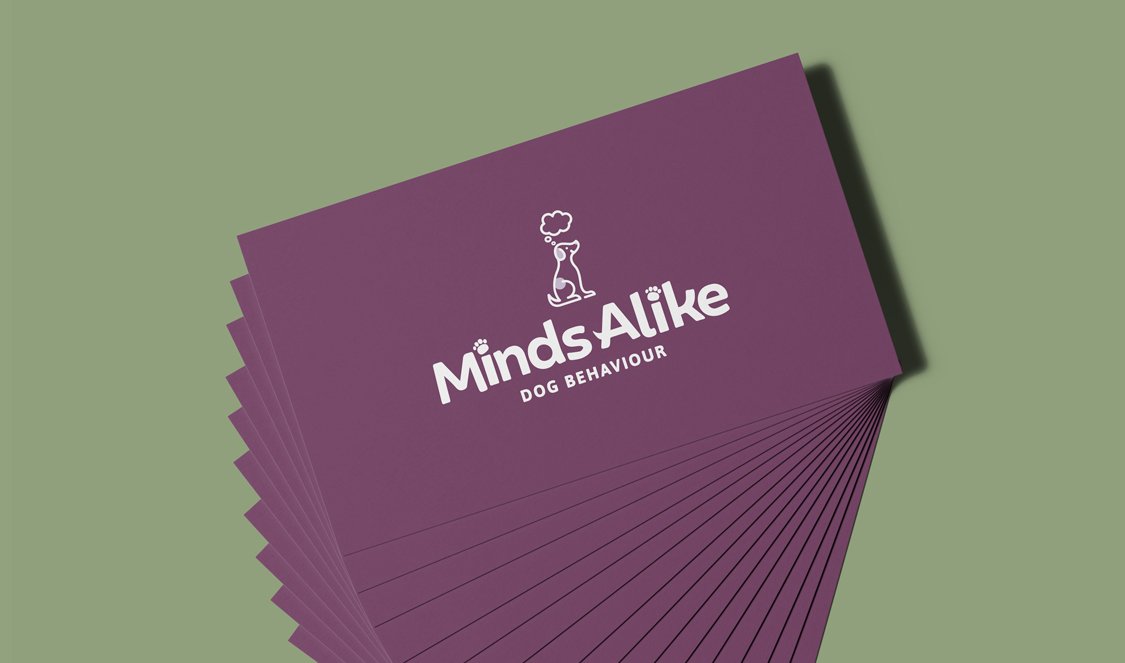
Here's an example from my own work. For Minds Alike Dog Training and Behaviour, I modified the font so the lettering had subtle dog-like features. It's a small, playful detail that ties the logo directly to the business. Custom lettering and one-of-a-kind marks like this are something AI tools simply don't do well. They work from what already exists, while custom type work starts with your business and builds something new. That kind of idea comes from understanding the client, not from a prompt. You can see more examples like this in my post on branding identity examples.
Experience Is What You're Really Paying For
When you work with an experienced designer, you're not just paying for a logo file. You're paying for years of knowing what works, what doesn't, and why.
After 15+ years, I've seen which design choices hold up over time and which ones look dated in a year. I know what tends to break in print, what gets lost on mobile, and what makes a brand feel trustworthy to a specific audience.
Experience also shows up before any design happens. My process starts with strategy: a brand questionnaire, a kickoff call, and a real conversation about your goals, your ideal clients, and what makes you different. Sometimes the most valuable thing a designer can do is tell you that what you asked for isn't quite what your business needs. AI won't push back. A good designer will.
Do You Actually Own an AI-Generated Logo?
This is the part many business owners don't think about until it's too late.
In the United States, copyright protection requires a human author. In March 2026, the U.S. Supreme Court declined to hear a case challenging that rule, which leaves it firmly in place. That means a logo created entirely by AI generally can't be protected by copyright, and someone else could create something very similar, or even use it, without much you can do about it under copyright law.
Trademark is a separate question. A logo can be registered as a trademark regardless of how it was made, but a generic-looking mark can be harder to set apart and defend. So you're back to the same problem: the more your logo looks like everyone else's, the less it truly belongs to you.
Please note: I'm a designer, not a lawyer. If ownership or trademark protection matters for your business, talk with an intellectual property attorney.
Where AI Fits in Branding in the Age of AI
I'm not anti-technology. I use AI-assisted tools in parts of my workflow, like research and organizing ideas, and I've shared how I use them in my post on how I optimize for AI search on Squarespace. The key is that AI is a tool in a skilled person's hands, not a replacement for strategy, creativity, or judgment.
If you decide to work with a designer, here are two things to keep in mind so you get the most out of that investment.
Don't Hand Your Designer AI-Generated Work to Execute
Some business owners create a logo or website with AI, then hire a designer to clean it up or rebuild it exactly as is. It sounds like a way to save money, but it usually isn't. You're paying for execution only and skipping the strategy and creative thinking that make a brand work. Fixing a weak concept often takes more time than starting with a strong one. You're also missing out on what a designer does best.
Don't Ask AI to Critique Your Designer's Work
It's become common to paste a designer's concepts into an AI tool and ask what it thinks. The problem is that AI doesn't know your goals, your audience, or the conversations you and your designer have had. It will give you generic feedback based on general patterns, which can pull your brand right back toward looking like everyone else's.
Your best feedback comes from you. Think about your goals, your ideal clients, and what you discussed together, and share your honest reactions. That's what helps a designer make your brand stronger.
FAQ
Can an AI-generated logo be copyrighted?
In the United States, generally no. Copyright requires human authorship, and work created entirely by AI doesn't qualify. Work that combines AI elements with significant human creative input may be protected, but only the human-created parts. For your specific situation, consult an intellectual property attorney.
Can I trademark a logo made with AI?
Trademark law focuses on how a mark identifies your business, not how it was created, so an AI-made logo can potentially be registered. However, generic designs can be harder to distinguish from other marks, which can make them harder to protect.
Why do AI logos all look the same?
AI tools learn from existing designs and produce results close to the average of what they've seen. As more people use the same tools and similar prompts, the results start to blend together.
How can I tell if a logo was made with AI?
Common signs include overly smooth gradients, generic icons, mismatched or odd lettering, and a design that looks polished but doesn't connect to the business. AI logos also often lose clarity at small sizes or in one color.
Are AI-generated logos vector files?
Usually not. Most AI tools create raster images made of pixels, which can look blurry or pixelated when enlarged. For print, embroidery, and signage, you need a vector logo, which a professional designer provides along with the other file formats your business needs.
Is it worth hiring a brand designer when AI exists?
If your business depends on trust and standing out, yes. A designer brings strategy, a trained eye, and a complete brand system built around your business. AI can produce an image, but it can't understand your clients or tell your story.
Your Brand Should Look Like You
Branding in the age of AI is about standing out when it's easier than ever to blend in. A strategic, thoughtfully designed brand builds trust, connects with the right clients, and truly belongs to your business.
If you're ready for branding that reflects who you are and what makes your business different, I'd love to help.